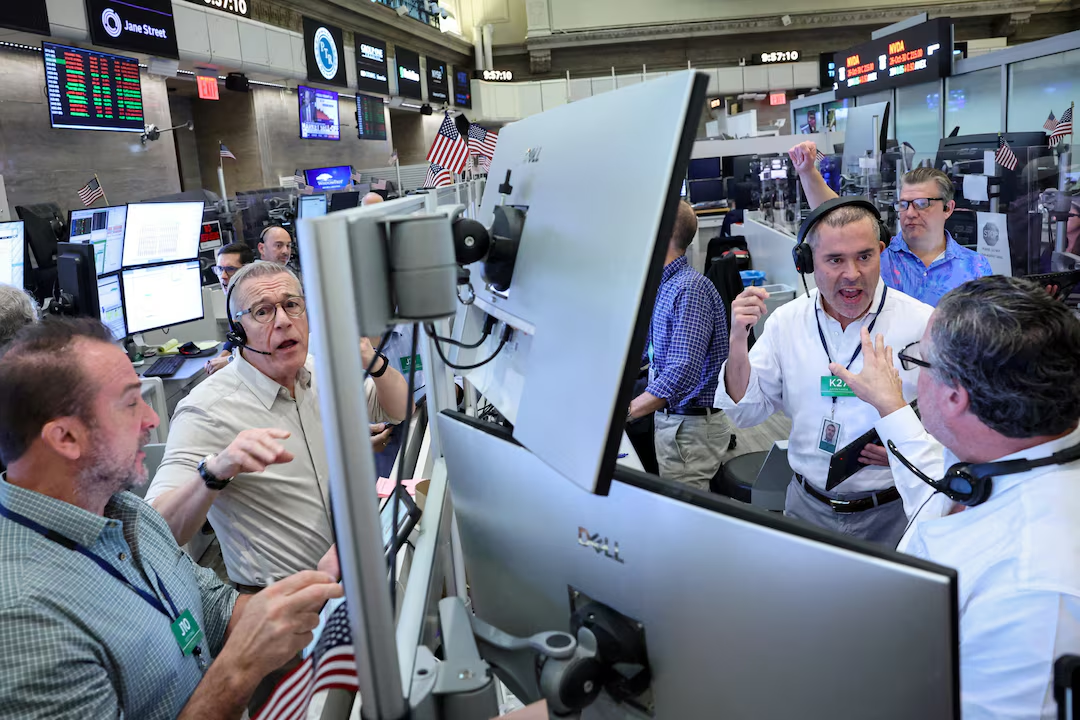
New York, October 30 — Monday will usher in a brand-new trading month—a prospect that, following a difficult final trading day in October, comes as a welcome relief to many.
The rally in tech stocks this year faced another test, with the Nasdaq Composite (.IXIC) sliding. On Friday, shares of Intel (INTC.O) saw their steepest decline since June, while social media company Reddit (RDDT.N) fell 29%. Meanwhile, chipmaker SanDisk (SNDK.O)—one of the primary beneficiaries of the AI-driven capital expenditure boom—saw its stock price drop by 13%.
Friday’s sell-off followed a sharp downturn among major tech companies—led by Microsoft (MSFT.O), Meta Platforms (META.O), Amazon (AMZN.O), and Google parent company Alphabet (GOOGL.O)—that are at the heart of artificial intelligence infrastructure development.
Following significant declines earlier in the week, shares of these companies fell by another 1% to 2% on Friday.
According to Capital Economics, these four “hyperscalers” have accounted for more than a third of the total capital expenditure by S&P 500 companies over the past 12 months—a share that appears poised to grow even further, a prospect that has left investors concerned.
“The current capital expenditure boom among hyperscale data centers is partly reliant on external financing, and investors are becoming increasingly concerned about the scale and structure of these joint investments,” said John Higgins, a market economist at Capital Economics.
The Nasdaq 100 index (.NDX) fell 3.5%—having declined even further at one point—bringing it to the threshold of a “correction,” defined as a 10% drop from a recent high. The Nasdaq Composite index is now 7.8% below its recent closing peak, following its worst month since March 2025—a decline that has wiped out the gains driven by artificial intelligence earlier this year.
“Investors have, all of a sudden, collectively cast their votes on who gets to cash out their investments and who doesn’t,” says Brian Jacobsen, chief economic strategist at Annex Wealth Management.
The impact of this sell-off extends well beyond the tech stocks that had recently climbed on a wave of market optimism; it reflects a broad retreat in risk assets as U.S. Treasury prices have risen. Silver fell 6%, bringing its year-to-date decline to 31%, while gold dropped 3.5%, down 10% for the year so far.
However, investors note that much of the recent sell-off in the stock market appears, at first glance, to follow the principle that “things turn into their opposites when they reach an extreme.”
“I don’t think the leverage issue we’re facing is particularly dire,” says Sahak Manuelian, Managing Director of Global Equity Sales and Trading at Wedbush Securities. “The entire sector has experienced a massive run-up.”
A 2% rise in oil prices has intensified concerns regarding the health of the U.S. economy—an economy that many investors believe is currently reliant on the build-out of artificial intelligence. Financial stocks took a heavy hit; shares of Goldman Sachs (GS.N) fell 4%, while Jefferies (JEF.N) dropped 6%. Meanwhile, Bitcoin fell 3% following a hack in which over $6 billion was stolen from the exchange Binance.
A key question for investors is whether the new month will mark a fresh start, especially after many chose to de-risk—opting to exit positions rather than wait to see how the market would move over the weekend.
“When a market experiences a parabolic move, it often sets the stage for a significant downturn,” Manuelian says. “I believe that is exactly what we are seeing now. People are pulling their capital out and shifting it elsewhere.”