Large language models (LLMs), such as OpenAI’s ChatGPT, are trained to recognize patterns in written text, enabling them to select words with a high statistical probability to complete sentences. Paleontologists have now trained a similar model—using the fossil record instead of words—to reconstruct a timeline of changes in Earth’s biodiversity over hundreds of millions of years with unprecedented detail.
The developers of this model suggest that using big data to interpret the rock record—a field known as stratigraphy—could prompt a re-evaluation of major upheavals in the history of life. For instance, the model indicates that three of the “Big Five” mass extinction events were characterized by a gradual decline in biodiversity, rather than the sudden, catastrophic events depicted in other reconstructions.
Shen Shuzhong, a paleontologist at Nanjing University in China, described the model as “a real revolution for studying stratigraphy and changes in biodiversity over time.” He presented the research findings on October 12 at a meeting of the Geological Society of America in Denver, Colorado.
Other researchers noted that while this model—dubbed “OneStrata”—appears to be the most detailed global record to date, scientists already possess high-resolution reconstructions of biodiversity changes for specific locations, many of which reveal mass extinction events.
“We can do some extra things with it, but I’m not sure if it’s going to be a game-changer,” said Matthew Clapham, a paleontologist at the University of California, Santa Cruz.
News
October 20, 2026
Massive New Fossil Record Challenges the Narrative of Earth’s “Big Five” Mass Extinctions
An artificial intelligence model trained on nearly four million fossils suggests that three of these extinction events may have unfolded much more slowly than previously thought.
By James Dinneen
Email, Facebook, LinkedIn, Reddit, WhatsApp, X
Save Article
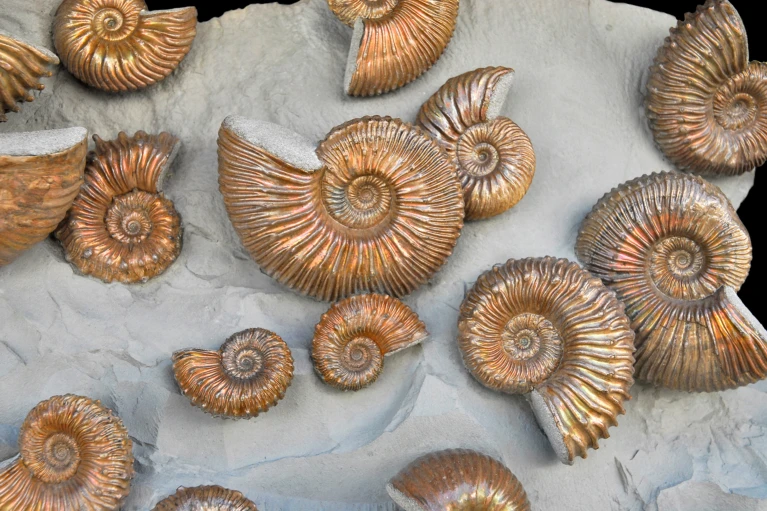
A spiral-shaped ammonite fossil shell embedded in the surface of light-gray rock.
An ammonite fossil preserved in limestone. Such fossil deposits help scientists understand biodiversity throughout Earth’s history. Credit: Herve Conge/Science Photo Library
Large language models (LLMs)—such as OpenAI’s ChatGPT—are trained to recognize patterns in written text, enabling them to predict the most statistically probable words to complete a sentence. Paleontologists have now trained a similar model using the fossil record instead of text, employing it to reconstruct a timeline of biodiversity changes on Earth over hundreds of millions of years with unprecedented detail.
The model’s developers suggest that this approach—using big data to interpret the rock record (a field known as stratigraphy)—could prompt a re-evaluation of major upheavals in the history of life. For instance, the model indicates that three of the “Big Five” mass extinctions were actually gradual declines in biodiversity, rather than the sudden, catastrophic events depicted in other reconstructions.
Supercomputer Scours Fossil Record for Hidden Mass Extinction Events on Earth
Shen Shuzhong, a paleontologist at Nanjing University in China, described the model as “a true revolution in the study of stratigraphy and past biodiversity changes.” He presented the findings on October 12 at a meeting of the Geological Society of America in Denver, Colorado.
Other researchers note that while this model’s reconstruction—dubbed “OneStrata”—appears to be the most detailed global record to date, scientists already possess high-resolution reconstructions of biodiversity changes for specific locations, many of which clearly reveal mass extinction events. “We can do some extra things with it, but I’m not sure if it will be a game-changer,” says Matthew Clapham, a paleontologist at the University of California, Santa Cruz.
Strata in a Bind
The history of life’s evolution is etched into the fossil record. By noting the depths at which species appear within layers of sedimentary rock—known as strata—researchers can reconstruct the grand narrative of adaptation and extinction throughout Earth’s history; these depths correspond to the time periods when the fossils were deposited. However, integrating sequences from a multitude of locations, involving tens of thousands of species, into a coherent timeline of biodiversity change is a computationally daunting task.
To simplify this, stratigraphers divide the fossil sequences of individual organisms into time intervals spanning millions of years. While this facilitates the integration of various sequences into a unified whole, it also creates a blurred perspective, obscuring biodiversity shifts that occur over shorter timescales.
For the past two decades, Shen and his colleagues have worked to achieve a clearer stratigraphic picture by compiling a massive dataset of fossils and other geological information, dubbed “OneStratigraphy.” This dataset contains depth data for millions of fossil specimens found within rock sequences at tens of thousands of sites worldwide.
Large-Scale Fossil Modeling
In 2020, Shen and his colleagues utilized a supercomputer to run an algorithm that stitched together thousands of these sequences, enabling them to estimate the appearance and extinction times of species with a resolution of 26,000 years—a significant improvement over previous estimates. They subsequently reconstructed a high-resolution evolutionary timeline for 11,000 marine species spanning approximately 300 million years¹. Yet, incorporating a greater number of species while narrowing the evolutionary time intervals would require an immense amount of computational power.
To overcome the limitations of computational power, Professor Shen’s colleagues at Zhejiang Lab—an artificial intelligence research institution based in Hangzhou, China—leveraged data from OneStratigraphy to train a machine learning model based on statistical patterns found in the fossil record. Much like how large language models (LLMs) use training data to predict the next word in a sentence, the OneStrata model utilizes these patterns to predict the most likely depositional time for a given fossil.